

This is the programme as it was on 10 October 2026, kept unchanged for groups who pinned it. See the current version
Skip to the contentSession 4
Hearing someone out
In a tense room we often listen while preparing our reply. Saying back what we heard shows people they have been understood, even when we disagree.
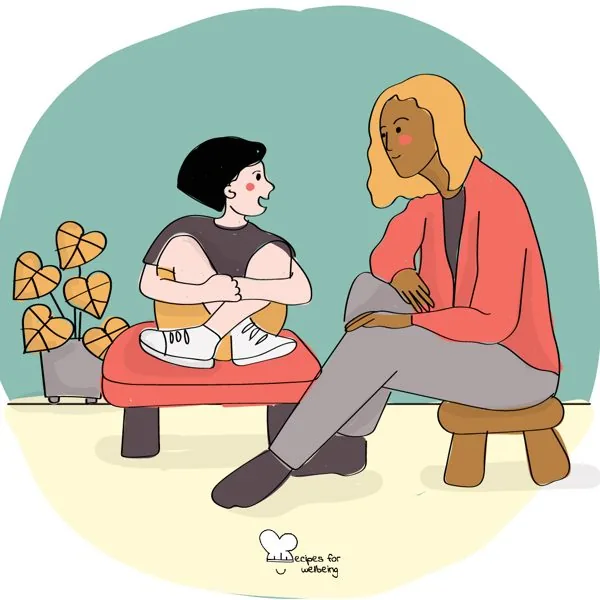
The card
5 minNinety seconds of nothing, about 3 minutes, in its adult wording.
For the next ninety seconds there is nothing you need to produce, and nothing you will be asked to show afterwards.
Let your eyes rest wherever is comfortable and let the chair hold some of your weight. If you are on a call, you can turn your camera off.
Your mind may say this is pointless or remind you of the next task, and you can notice those thoughts without following them.
I will keep the time so that you do not have to. The ninety seconds begin now.
Anyone can pass, and quiet is taking part.
A short talk
10 minIn a tense room we often listen while preparing our reply. Saying back what we heard shows people they have been understood, even when we disagree.
Talk notes
- In experiments, speakers who were listened to well, with attention and without judgement, held their own views with less defensiveness and more nuance.Itzchakov, G., Kluger, A. N., and Castro, D. R. (2017). I am aware of my inconsistencies but can tolerate them: The effect of high quality listening on speakers' attitude ambivalence. Personality and Social Psychology Bulletin, 43(1), 105 to 120. doi:10.1177/0146167216675339
- Field experiments with door-to-door conversations found that listening without judgement and exchanging personal stories reduced prejudiced attitudes, with effects lasting months.Broockman, D., and Kalla, J. (2016). Durably reducing transphobia: A field experiment on door-to-door canvassing. Science, 352(6282), 220 to 224. doi:10.1126/science.aad9713
- Saying back what we heard is a small, checkable act: the speaker can tell us whether we got it right.
Discussion
10 minQuestions in pairs or small groups. Anyone can pass.
- What makes it hard to listen well when you disagree?
- How can you tell when someone has really heard you?
The activity
30 minOnline
In breakouts of two, one person talks for 90 seconds about a light work moment while the other listens without advising or steering. The listener says back one sentence starting "What I heard was..." and the speaker can correct it. In a second round, take a mild question you see differently and say back the other view without arguing. Cameras can stay off; say back by voice or in the breakout chat.
In a room
The same in pairs, facing each other or side by side, whichever is more comfortable.
The fictional case. Choose the one closest to your group:
- How long meetings should run.
- Whether email after 7pm is fair.
- Whether to meet online or in person.
Private reflection
10 minTry it this week. In one conversation this week where you disagree, say back what you heard before you reply. Then ask whether you got it right.
Before you try it, the field log asks:
- What matters most to me in this conversation?
- What am I assuming about them?
- What will I do when I notice the first sign of stress?
Quiet time. Nobody shares what they write.
Closing
5 minOne word or one line from everyone.
For your peer circle. What happened when you said back what you heard before you replied?
Five to spare
5 minBecause sessions run over, and that is fine.
Practices to try at home.
Your email opens with this session named in the subject, and nothing is sent until you send it. A person reads these.
Or write to info@recipesforwellbeing.org
Take the practices into your group
Every lesson and card these sessions draw on is free to download, with plans you can edit and adapt for adults.
Or only the cards: printable PDF or slides to project.

