

This is the programme as it was on 10 October 2026, kept unchanged for groups who pinned it. See the current version
Skip to the contentSession 6
Room for every voice
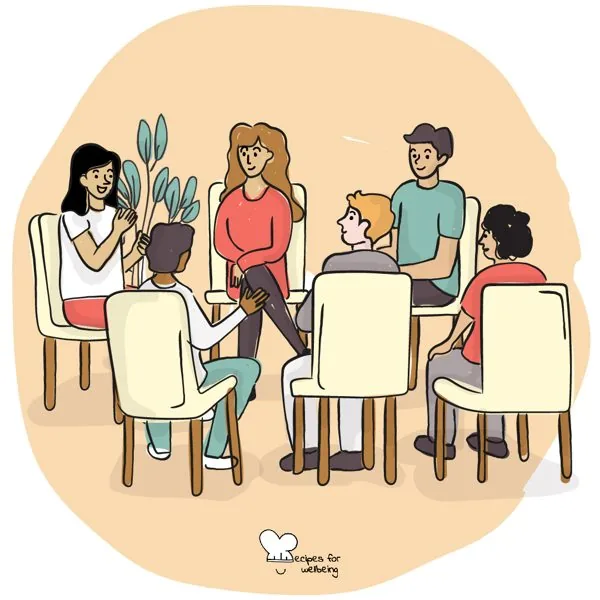
Tense meetings tend to favour the quickest and loudest people. Small hosting moves, such as an open question or a short silence, can make room for everyone else.
The card
5 minThree quiet wishes, about 4 minutes, in its adult wording.
Rest your hands wherever is comfortable and take a moment to arrive.
Begin with a quiet wish for yourself, in words that feel natural to you, such as "May today feel a little easier."
Offer the same wish silently to someone you care about, without needing to say who they are.
Finally, extend a kind wish to this whole group, including the people you do not know well yet.
Anyone can pass, and quiet is taking part.
A short talk
10 minTense meetings tend to favour the quickest and loudest people. Small hosting moves, such as an open question or a short silence, can make room for everyone else.
Talk notes
- Woolley and colleagues found that groups where people took more equal turns in conversation tended to do better across a range of tasks than groups dominated by a few voices.Woolley, A. W., Chabris, C. F., Pentland, A., Hashmi, N., and Malone, T. W. (2010). Evidence for a collective intelligence factor in the performance of human groups. Science, 330(6004), 686 to 688. doi:10.1126/science.1193147
- Edmondson found that teams whose members felt safe to speak up and take small risks with each other learned more from their mistakes.Edmondson, A. (1999). Psychological safety and learning behavior in work teams. Administrative Science Quarterly, 44(2), 350 to 383. doi:10.2307/2666999
- Hosting moves such as a pause before deciding, or asking who has not spoken, are small ways to share airtime. Who holds power in the room still shapes who speaks.
Discussion
10 minQuestions in pairs or small groups. Anyone can pass.
- Whose voices tend to go missing in the meetings you know?
- What small move from a host has made room for you?
The activity
30 minOnline
In breakouts of four or five, decide something with real trade-offs, using the fictional case below. Each person has a speaking budget of three turns, which they track themselves. A host asks open questions, holds short silences and checks whose view is missing. Back in the main room, talk about power, airtime and whose ideas got the credit.
In a room
Groups of four or five at a table, with three tokens each to spend on speaking.
The fictional case. Choose the one closest to your group:
- How a small community group spends a modest grant.
- Which of three campaigns a coalition puts first this year.
- How a clinic team shares out a rota no one likes.
- Whether a youth club spends its budget on trips or on staff.
Private reflection
10 minTry it this week. In your next meeting, try one hosting move, such as a pause before deciding or asking who has not spoken yet. Notice who comes in.
Before you try it, the field log asks:
- What matters most to me in this conversation?
- What am I assuming about them?
- What will I do when I notice the first sign of stress?
Quiet time. Nobody shares what they write.
Closing
5 minGiving and receiving, about 5 minutes, in its adult wording.
Before we close, we will practise offering an appreciation and receiving one without brushing it away.
Think of something small and genuine you appreciate about your partner, from something they did in this session. You can pass if the pairing does not feel comfortable.
Offer it in one sentence, or use "Thank you for being part of this session with me" if you need a starting point.
When you receive one, say "thank you" and let the words land before you swap roles.
Notice privately whether giving or receiving felt less familiar.
Anyone can pass, and quiet is taking part.
For your peer circle. Who came into the conversation when you made room, and what did they bring?
Five to spare
5 minBecause sessions run over, and that is fine.
Practices to try at home.
Your email opens with this session named in the subject, and nothing is sent until you send it. A person reads these.
Or write to info@recipesforwellbeing.org
Take the practices into your group
Every lesson and card these sessions draw on is free to download, with plans you can edit and adapt for adults.
Or only the cards: printable PDF or slides to project.

