
NVC dance floor
Expressing our vulnerability can help resolve conflicts. ―Marshall Rosenberg
👥 Serves: 2-10 people
🎚 Difficulty: Hard
⏳ Total time: 31-60 minutes
🥣 Ingredients: 1 facilitator, 4 slips of paper, 1 spacious room, empathy, honesty, “Nonviolent communication: A language of life” book by Marshall Rosenberg (if you’re curious to find out more about it!)
🤓 Wholebeing Domains: Awareness, Community, Discomfortability, Liberatory Learning
💪 Wholebeing Skills: Accountability, Clarity, Conflict transformation, Feedback, Holding space, Multiperspectivity, Non-judgement, Relating to Others, Vulnera-bravery
NVC dance floor
📝 Description
A dance floor to transform conflicts.
Non-violent communication is a “language of life” that helps you transform old patterns of defensiveness and aggressiveness into compassion and empathy to improve the quality of your relationships. By encouraging you to focus on the here and the now, it raises awareness of internalised behaviours that are violent, both towards yourself and towards other people. This model is useful to transform tensions arising in between two people or in a group by fostering empathy, compassion, and acceptance.
We live in a world where violence has become more and more socially accepted and normalised. It is important to note that violence goes beyond physical confrontation such as war and conflict. If you do not experience physical confrontation or abuse, you may think that violence is not present. But non-violence does not refer to the mere absence of physical harm. It is a way of life that takes its lead from a compassionate and connected heart and can guide us towards a more wholehearted way of being and acting in the world.
This method is particularly important for changemakers because of the often-delicate nature of their work. Additionally, it invites them to reflect on their own violent attitudes and behaviours, even towards themselves. For instance, when a changemaker does not get a grant they applied for, they might react by saying: “I’m a failure. I’m not good enough for this.” These words are violent and do not support the changemaker in growing personally and professionally.
The basic model for non-violent communication, created by Marshall Rosenberg, is a process that combines four components (explained in the process below) with two principles. The two principles are:
- Empathy: Receiving from the heart creates a means to connect with others and share experiences in a truly life-enriching way. Empathy goes beyond compassion, allowing us to put ourselves in another person’s shoes to experience their feelings and understand their needs. It gives us the means to stay present and be aware of our own needs and the needs of others even in extremely difficult situations.
- Honesty: Giving from the heart has its roots in honesty, which begins with truly understanding ourselves and our own needs and being in tune with what is alive in us in the present moment. When we learn to give ourselves empathy, we can start to break down the barriers that keep us from connecting with others.
You can use this recipe in a few different ways:
- You may want to explore a relationship that is causing tensions in your life and work with a facilitator who will guide you through the process;
- You may want to do the same but also invite the person with whom you have a conflict to be present, so that the facilitator can guide you both through the process; or
- You may want to explore a relationship that is causing tensions in your life and work with a facilitator who will guide you through the process and a group of people who will support you by asking powerful questions. This is a “spicy” recipe as we call them so we strongly encourage you to work with a facilitator who has previous experience with NVC.
To find out more about non-violent communication, we invite you to read Marshall Rosenberg’s book Nonviolent communication: A language of life.
👣 Steps
Step 1 – Preparation (5’)
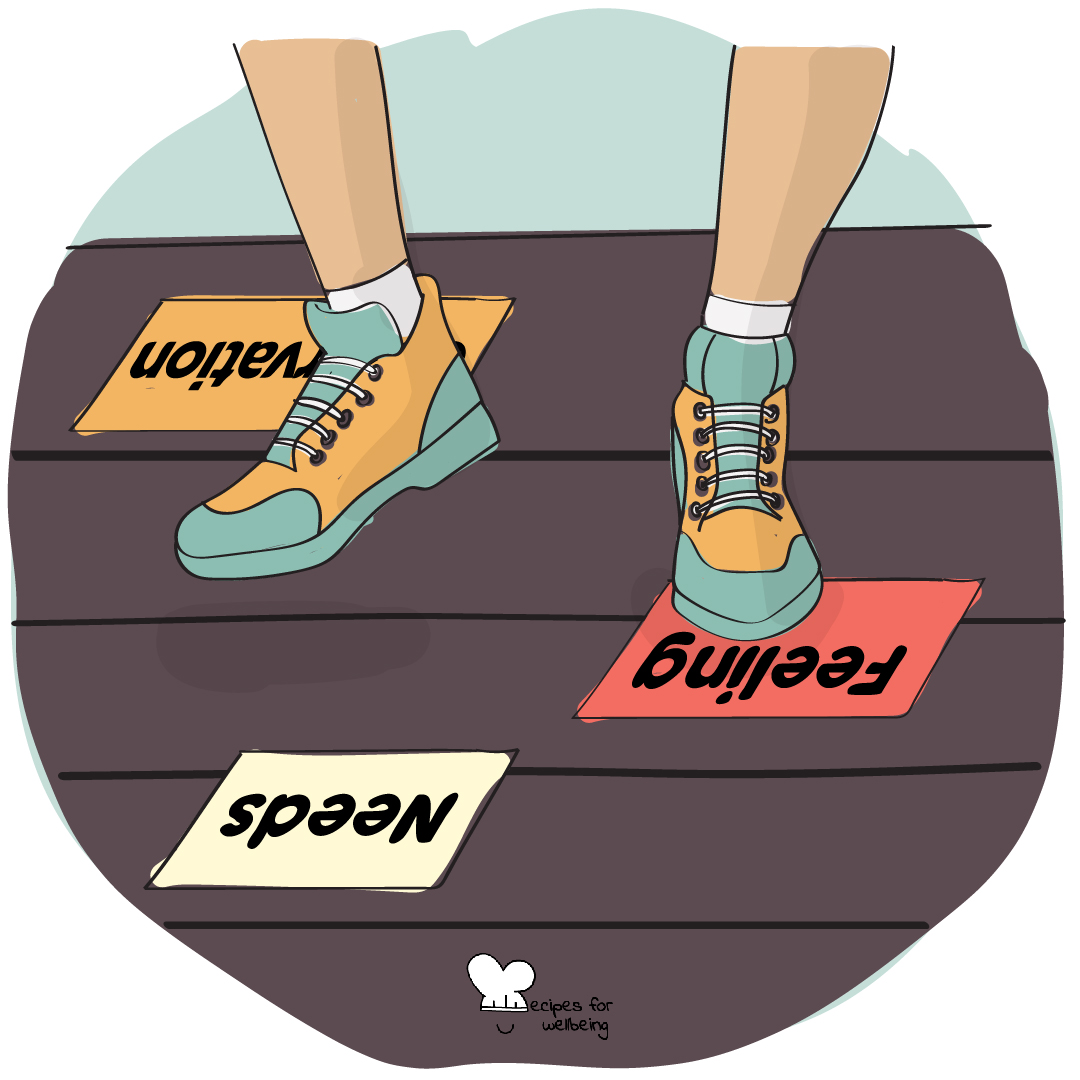
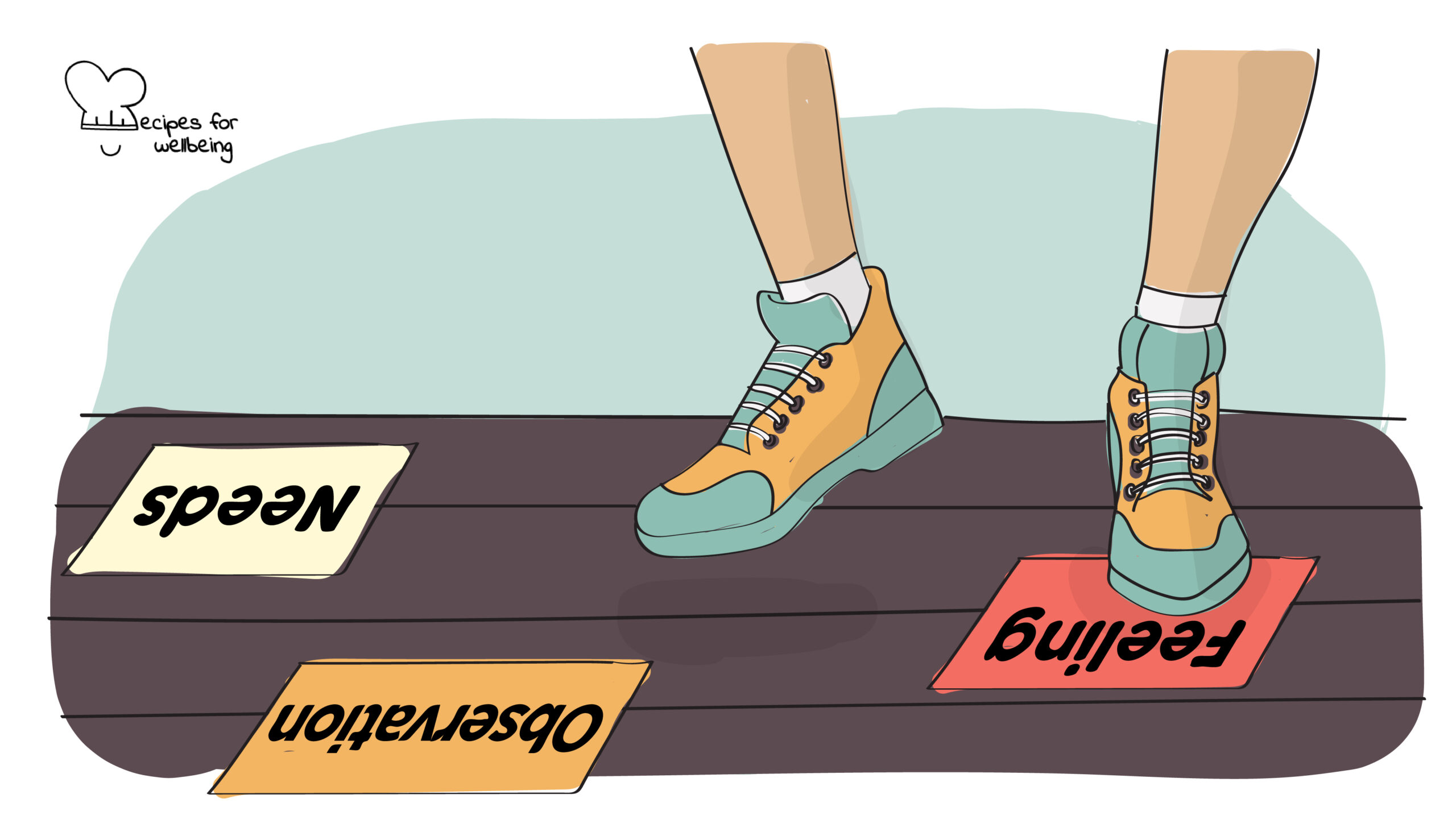
The facilitator sets up the room so that everyone can sit in a circle (if you are in a group) and ensures there is enough space in the middle for the volunteers to ‘dance’. They place four slips of paper on the floor, each of which has one component of the NVC process (see next step).
Step 2 – Introduce the concepts and the process (15’)
The facilitator introduces the concept of non-violent communication (see description), the two principles of empathy and honesty, and the four components of the process:
- Observation: Observation without evaluation consists of noticing concrete things and actions around us. It helps us distinguish between judgement and what we sense in the present moment, and it encourages us to simply observe what is there.
- Feeling: When we notice things around us, we inevitably experience varying emotions and physical sensations in each particular moment. It is essential that we learn to separate feelings from thoughts. Here is a list of feelings.
- Needs: All individuals have needs and values that sustain and enrich our lives. When our needs are met, we experience comfortable feelings; when they are not, we experience frustration, disappointment, upset… Recognising our needs allows us to separate them from our feelings and live empathically. Here is a list of needs.
- Request: To make clear and present requests is crucial to communicate non-violently. When we learn to request concrete actions that can be carried out in the present moment, we begin to find ways to cooperatively and creatively ensure that everyone’s needs are met.
We encourage you to spend as much time as needed here as it is important that the other person / people understand these four components.
Step 3 – Dance! (30’)
The facilitator invites the volunteer to step into the dance floor. This person can enter the dance floor wherever they would like, e.g. they might choose to step into the ‘observation’ and start sharing what they observe and notice about the situation, or they might want to start from the ‘feelings’ step and share how this situation makes them feel. The facilitator guides them through the dance floor by asking them powerful questions to deepen their self-awareness. It is important to know that this is not a linear process, so the volunteer may move back and forth on the NVC dance floor. Also, the facilitator should not be afraid of intervening to help the volunteer learn about themselves, e.g. raising awareness when they share their judgement instead of an observation, or highlighting when they are not sharing a feeling…
Step 4 – Formulate a request (5’)
The facilitator helps the volunteer to formulate their request. Marshall Rosenberg suggests a simple structure, which you can use for guidance.
When I see that _______________________
I feel _______________________
because my need for _______________________ is / is not met.
Would you be willing to _______________________?
Step 5 – Wrap up (5’)
The facilitator wraps up the NVC dance floor by inviting the volunteer to step out, they thank the volunteer for their openness and willingness to transform a conflict, and they leave space for final reflections. It is important that you think about where you ‘land’ your volunteer, as this process might be emotionally demanding for them, so encourage them to take it easy and care for themselves after the experience.