

The window of tolerance
The autonomic nervous system responds to the challenges of daily life by telling us not what we are nor who we are, but how we are. ―Deb Dana
👥 Serves: 1 person
🎚 Difficulty: Easy
⏳ Total time: 11-30 minutes
🥣 Ingredients: Somewhere to sit undisturbed for a few minutes
🤓 Wholebeing Domains: Awareness, Discomfortability, Positive Emotion
💪 Wholebeing Skills: Breathing, Calm, Centring, Mind-body-connection, Peacefulness, Presence, Relief, Self-regulation, Serenity, Stress management
The window of tolerance
📝 Description
Expanding your window of tolerance to spend more time in regulation.
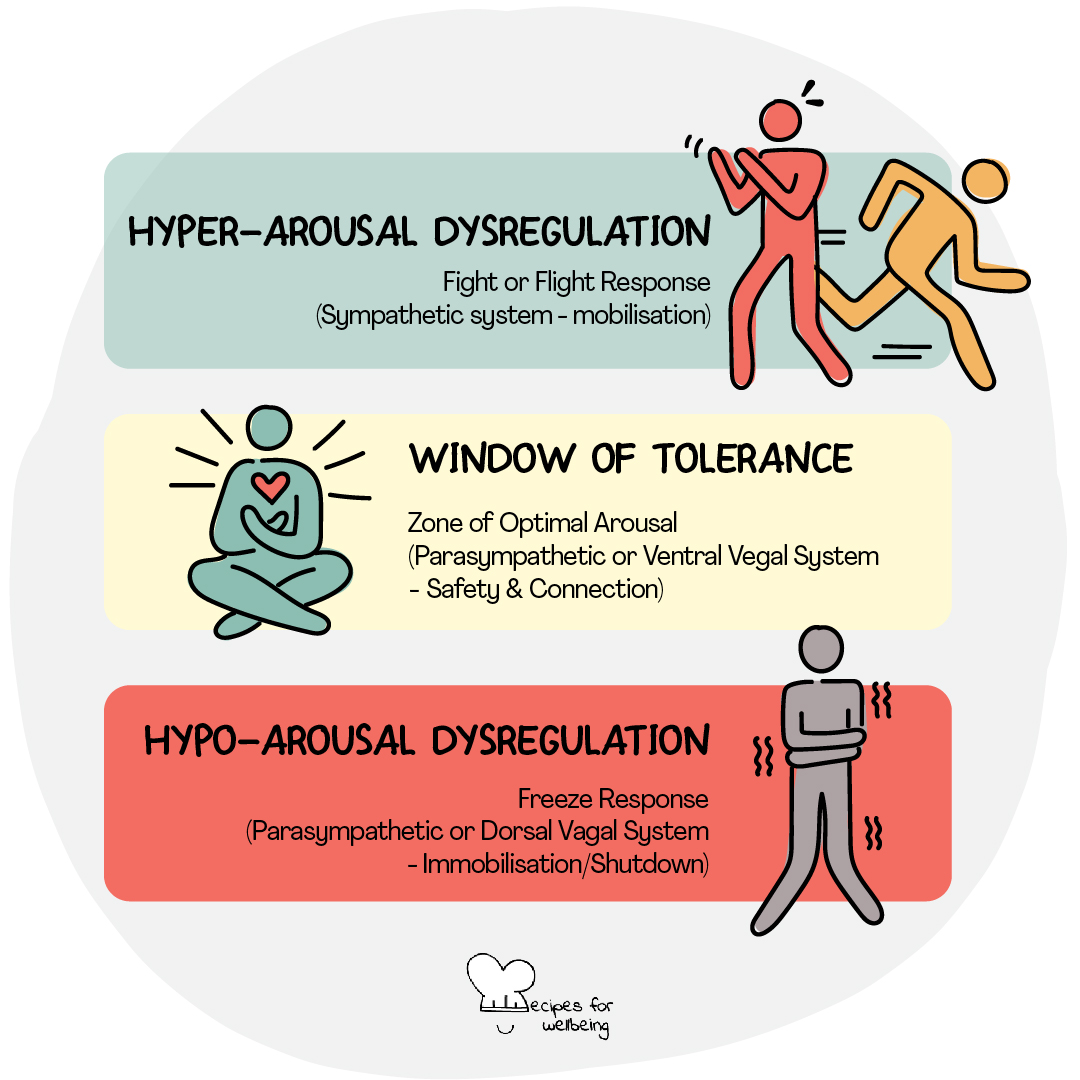
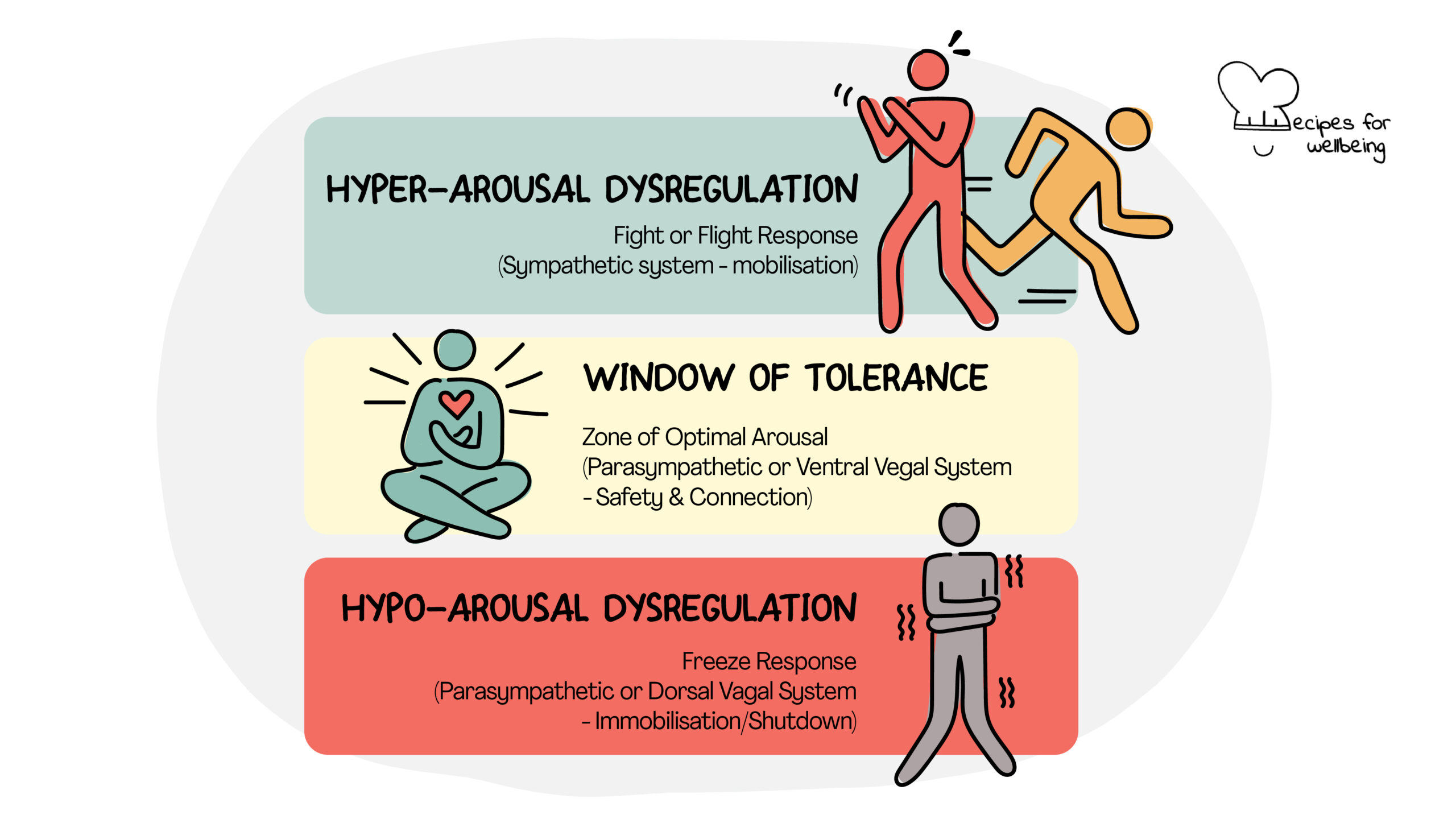
The Window of Tolerance, developed by Dr Dan Siegel in 1999, is a mapping tool that helps you understand and recognise your nervous system’s different states and draws on broader neurobiological understanding of the autonomic nervous system (ASN) and Dr Stephen Porges’ Polyvagal Theory. In particular, it describes the optimal zone of arousal where you can function effectively – you are emotionally regulated, cognitively flexible, and socially engaged. However, when arousal exceeds the upper threshold, you may experience hyperarousal and when arousal drops below the lower threshold, you may experience hypoarousal.
The following recipe helps you to recognise the qualities of the three states so you may expand your window of tolerance and spend more time in regulation. The suggested grounded and calming practices have been experienced by our co-founder Greta Rossi during the Healing Trauma Programme by Dr Jeffrey Rutstein.
IMPORTANT: Throughout any given day, your nervous system fluctuates between states. And none of these states is inherently “bad”. They are all adaptive responses that your nervous system has developed. The issue arises when you spend a lot of time outside the window of tolerance, which can lead to chronic activation or shut down. That’s when life can become exhausting and overwhelming.
🌟 Steps
Step 1 – Recognising the differences between the three states (5’)
Let’s have a look at the main characteristics of the three states.
- Window of Tolerance: This is the zone of optimal arousal, characterised by feeling safe, secure, and connected. In this state, you feel present, connected, and able to respond flexibly to what is happening around you. You can access qualities such as compassion and creativity. In this state, the parasympathetic system or ventral vagal pathways is/are activated.
- Hyper-arousal Dysregulation: This is the so-called “fight or flight” state, characterised by activation and mobilisation. Symptoms include feelings of overwhelm, panic, rigidity (both of mind and body), inflexibility, irritability, impulsivity, rage, fidgetiness, etc. In this state, the sympathetic system is activated.
- Hypo-arousal Dysregulation: This is the so-called “freeze” state, characterised by shutdown and immobilisation. Symptoms include reduced awareness of sensation, emotional numbness, inability to think, dissociation, feeling lethargic or sleepy, withdrawal. In this state, the parasympathetic system or dorsal vagal pathways is/are activated.
What is important to remember is that the dysregulated states are trying to protect you from some perceived threat; they are doing their job to keep you safe. Your nervous system feelings are telling you how you are: Are you feeling safe right now? Or are you feeling unsafe and threatened?
Step 2 – Grounding in the body (2’)
Whenever you are feeling dysregulated, you can return to the body – connecting to and listening to the physical sensations in your body – as a resource for calming, grounding, and presence. The first practice is grounding in the body, using your awareness to tune into sensations that help you become a little more present. This can be done standing or sitting.
If you are sitting, begin by sliding your feet slightly back and forth to make a good connection with the ground and feel a firm connection. Then engage your leg muscles to press down on your feel so you feel supported by the ground beneath you. Notice the sensations that arise from doing this.
Then, allow the chair to take your weight. Let it support you and feel what it feels like to be supported by the surface on which you are sitting.
Finally, expand your awareness to include all the points of contact, the places your body meets the floor or the surfaces on which you are sitting, as well as the places where clothing might make contact with your skin. The key here is not to think about these points of contact, but to sense them.
Step 3 – Elongated out-breath (2’)
If you’d like, you can add a second practice to the grounding in the body. It consists in an elongated out-breath through pursed lips, twice as long as the in-breath. Doing this automatically helps activate the branch of the vagus nerve that helps you move towards balance, relaxation, and calm.
After a few elongated out-breaths, does the mind feel a bit more quiet?
Step 4 – Containment hug (1’)
Finally, there is a third practice you can add – a containment hug. Take your right fingers and place them underneath your left armpit. Then take your left arm and grab your upper bicep or elbow or shoulder (right side). Then draw your arms closer towards your chest, putting a little pressure on your sternum.
As you do this, notice what happens with the rest of your body and mind.
Step 5 – Repeat whenever needed (ongoing)
You can come back to these practices (separately or combined) anytime you need support shifting from activation or immobilisation to ventral safety and connection. The more you practice, the easier it will be to call upon this skill whenever needed.
Step 6 – Reflection (5’)
If you’d like, spend a few minutes to reflect on the following prompts:
- Where do you spend the majority of your day?
- What tends to push you towards hyper- or hypo-arousal dysregulation?
- What usually helps you find your way back to ventral safety and connection?
If you are interested, check out these recipes to manage the different stress responses: Managing the fight response, Managing the flight response, Managing the freeze response, and Managing the fawn response.